Showing posts with label brightness in 3D film. Show all posts

Saturday, June 21, 2014

How's the 3D in Edge Of Tomorrow?


Background:

Following hot on the heels of Top Gun's 3D re-release, Edge Of Tomorrow gives audiences another change to see Tom Cruise's million-watt smile in 3D. The film is based on a Japanese novel called All You Need Is Kill, though it deviates somewhat from the story's plot. The tale itself is a hodgepodge between Groundhog Day, Looper and director Doug Liman's own The Bourne Identity, while also calling to mind the rewards-based repetition that modern video games offer their players. More importantly than all that though, how is the 3D in Edge Of Tomorrow? Read on in our 3D-focused review to find out all you need to know!

Post-Converted 3D:

Edge Of Tomorrow was post-converted from 2D to 3D by Prime Focus World. Their approach to this film seems to be unique in 2014's crowded slate of post-converted films. Rather than hide the technique with a 'native lite' approach, they appear to have been directed to dial up the stereo at pivotal moments and dial it down in others. The beginning sequence is seemingly intentionally dull, before the visuals are dramatically opened up in a chaotic battle scene. We've seen visual 'kicks' before (think of the difference in The Wizard Of Oz between Kansas' monochromatic colours and the Technicolor world of Oz) but this is the first time we can recall one being initiated by a post-conversion team so strikingly.

The beginning sequence of Edge Of Tomorrow has 'flat' feeling 3D

The key to their success appears to be, perversely, how much of the opening sequence is kept close to its native 2D source. This lulls the audience's eyes into a relaxed state, before the post-conversion team shockingly uses scaled negative parallax to literally yo-yo soldiers in and out of the frame. It's a refreshingly brazen technique, and serves the narrative well; our anti-hero is being thrown from a comfortable world into a stark and gruesome reality. The shock is appropriate, and not as gaudy as it could have been in other contexts. The post-conversion team served the narrative well here, and it's likely the shock they were able to convey could not have been achieved if the film were shot in native 3D.


How's the depth of the 3D?

The depth varies wildly throughout the film. The battle scenes opt for a 'deep focus' that allows you to see for miles into the distance. Or, at least, you could if the camera kept still for long enough. The battle scenes are the most interesting visually, in that they provide an arresting focal point for each of Tom Cruise's character's (Cage) loops. One character dies as an object drops from the sky on him, and then in Cage's next iteration through the loop Cage saves the man before the object drops, and then the next loop Cage doesn't bother. Knowing the exact geography of the scene is important for Cage, and it's incredibly important the audience knows the impact of a character standing even a metre from their 'usual' position.


The film-makers attempt to show Cage's growing confidence grow with each new iteration. The camerawork is shaky and chaotic in his first few attempts at battle, and then slowly grows more steady and assured as he begins to learn the ropes. Unfortunately, this also means that the audiences eyes are expected to context-shift with each new iteration of Cage's battle. Your perception shifts from loop to loop; progressing from only seeing a few feet of depth behind Cage in his first loop, through to being eventually able to see for miles behind him as his skills develop. After enough rapid-fire edits and changes to the way the action is filmed, your eyes might wary and tire from all this visual change.


Does the 3D 'pop'?

As mentioned earlier, the opening battle scene is the primary example of negative parallax being used. Soldiers are thrown from a moving plane into a battle field below them, and some are accidentally suspended to the plane by rope. As the plane descends, they're flung at the audience in a yo-yo like technique that we wished had been included in The Amazing Spider-Man 2. The remainder of the film uses this type of technique relatively rarely, with the only 'popping' elements usually being restricted to debris and out of focus guns aimed at the camera. Again, this kind of inconsistency can contribute to some amount of eye strain, as audiences eyes attempt to process the inconsistently applied visuals.

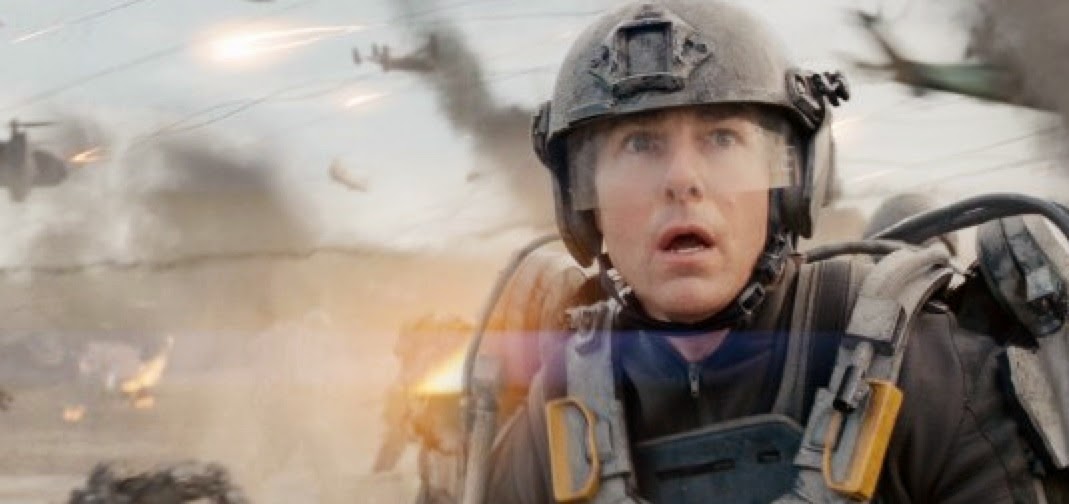
Dull night-time visuals, with a lack of background contrast

Did it make sense to add 3D to Edge Of Tomorrow?

The film-makers made a lot of good choices when considering the idea of Edge Of Tomorrow as a 3D film. The action is largely set in daylight, and the characters contrast well against their backgrounds. However, they made a few missteps once the second act is over. The climactic set piece is largely set in the evening, and it's very hard to differentiate the dark-suited soldiers from their background. Their enemy is cloaked in shadow and similarly hard to pick out visually. Without the kind of bright neon offered in films like Prometheus or Tron: Legacy, these night-time scenes suffer visually, particularly if your local multiplex hasn't adjusted the brightness of their projector to accommodate 3D projection's light loss. Just in case you hadn't noticed a recurring theme in our review; this narrative and visual choice can also lead to eye strain in audiences.


The film itself

Edge Of Tomorrow is one of the most arresting and relentlessly entertaining blockbusters to have been released in recent years. Simply put, it's a gem of a sci-fi/action film. If you're a fan of shoot 'em up video games, this is the film for you. If you're a fan of the enigmatic and interesting stars, then this is further proof that they're A-list talent. If you've ever bemoaned the influx of comic book movies and sequels in the American Summer movie-going season, then you'll find Edge Of Tomorrow's originality refreshing. If you ever watched an action film and wished the female lead were tougher and more heroic than the male, then Emily Blunt's steely performance is going to make you feel better about Hollywood. It's a joy of a movie, let down only by a somewhat anti-climactic final minute of footage. If there were Oscars for crowd-pleasing films, this would be nominated in several categories.

If we had to archive one version, should we save the 2D or the 3D?

If you have the choice, see Edge Of Tomorrow in 2D. Buy the 2D Blu-Ray. Avoid the 3D version unless you're really curious. It's disappointing for us to say, but the 3D version is a noble failure. There's a bunch of great examples of stereo on display, but the eyestrain we suffered while watching can be traced back to several poor visual choices that other film-makers would do well to learn from. Just because you can post-convert from 2D to 3D, doesn't mean you should.

Sunday, June 15, 2014

How's the 3D in X-Men: Days of Future Past?


Background:

It could be argued that the first X-Men (2000) film began the modern-day phenomena of blockbuster superhero franchises. 4 films and 2 spin-offs later into this series, X-Men: Days of Future Past arrives in 3D, directed again by the series' original helmer, Bryan Singer. This is not the first time we've seen Wolverine and his pals in 3D, so we've a lot of precedent to judge this effort against. How's the 3D in X-Men: Days Of Future Past? Read on to find out!

Native and Post-converted 3D

X-Men: Days Of Future Past is a hybrid stereo film. Interior and dialogue scenes were largely shot in native 3D. Several key sequences were post-converted sequences from a mono source. Other shots are largely CGI in nature, and the responsible effects houses were able to natively render their footage to stereo. It's therefore quite a confusing film to critique. To do the job properly, one would need a shot list or production schedule. We'll do our best though.


As a rule of thumb, most "first unit" sequences (character beats that would typically be directed by the director himself, and featuring the A-list stars) set indoors are clearly shot in native 3D. An observant audience member will be able to tell the difference. The trick is to look for subtle details; strands of hair, the length of an actor's nose, or even just compositional details like the layers of props on a table. In these scenes, it's interesting how at ease your eyes become. The camera is often locked down, actors are interacting in multiple panes of depth, and the stereo feels completely natural. You're there, say in Professor Xavier's mansion, with the other X-Men. These sequences were shot on ALEXA Ms.

Credit: http://www.arri.com/news/alexa-xt-on-x-men/
"Second unit" sequences (eg: the type of moment that doesn't usually require an expensive star, such as a shot where a hand picks up an object) are often show in 2D, and later post-converted to 3D. The same is true of large sequences that are shot on older film stock, using cameras from the 1970s, where the footage was later converted to a subtle form of stereo too. The conversion is handled well, and there are no glaring errors in the added depth. Aside from having marginally more eye strain, most audience members won't be able to tell the difference. What's interesting though, is the 'feeling' one gets from this rapid-fire transition. According to editor John Ottman, he edited the film in 2D, while the mono footage was being converted to stereo, because the cuts between the two formats were so regular and jarring that he couldn't process the visuals consistently. While audiences are thankfully spared from experiencing this, we at 3Defence definitely came away with a feeling that the film lacked a stereoscopic 'continuity'. Post-conversions are great, until they're compared to native 3D in the same sequence. These sequences were shot on ALEXA XT's.

Of course, as usual with most Hollywood blockbusters, there are also shots in the film that are 'rendered 3D'. In shots where the majority of the action is a composite of shots with digital characters (for example, a few shots of Sentinels in the beginning sequence), it's more than likely that the effects studios in charge of the shots provided the stereo rendered 'natively'. So, X-Men: Days Of Future Past is a hybrid of techniques.

How's the depth?

As mentioned above, the visual continuity is inconsistent throughout X-Men: Days Of Future Past. That is due to a number of reasons, in addition to the differing methods of filming. For one thing, large sections of the film's schedule were aggressively organised around the ensemble cast's availability. For another, the film went through several rewrites (even during production), major edits, and even rearranged which actors were part of key scenes.


So, ignoring the inconsistency of depth used in the film, we can look at a few shining moments where depth is used really creatively. The stand-out sequence, both from an entertainment perspective and a technical perspective, is a prolonged slow-motion one where Quicksilver single-handedly disarms and defeats several foes. The character's power is to be able to "move and think at superhuman speeds." Consequently, like The Amazing Spider-Man 2 before it, we're offered another version of a bullet-time like sequence, where a character is able to interact with a chaotic environment where objects are suspended in mid-air. Aside from being hilarious, the sequence allows the character dozens of objects to interact with and run around, on various panes of depth. It's an engaging sequence visually, and single-handedly worth the price of admission.

 
Another fantastic sequence is provided in the way Blink's powers are used in the film's first big action set-piece. She can project an entry and exit portal, that allows characters to jump through a kind of wormhole. In 3D, we get to see characters leap from one side of the room to the other, to startling effect. Just as your eye learns where a character is in the scene, the character is transported to a different spacial plane, forcing your eye to try and catch up. It's a power visual, that is used well in the beginning and end sequences of the film.


Does the 3D 'pop'?

There are a few instances where debris, water, dust and other particle-based elements come very close to the edge of the screen. Generally the film treats the screen's boundary as a safe barrier between the audience and the action. If you're after yo-yo styled pop-out effects, X-Men: Days Of Future Past is not the 3D film for you.

Did it make sense to add 3D to X-Men: Days Of Future Past?

In theory, it makes sense to add 3D to any X-Men movie. Their characters are colourful, with a variety of interesting powers, and in Days Of Future Past they interact across time and space. In practice though, this film spends a lot of time in a murky and dark post-apocalyptic future, and in 3D these scenes are distractingly gloomy. 3D projection's light-loss was evident in many sequences throughout Days Of Future Past, and we didn't feel the film-makers did enough to counteract this. Films like Prometheus and Tron: Legacy have worked around this issue with bright neon-flavoured yellows and blues. Days Of Future Past's 'fire-light' orange didn't have the same effect, and made the image softer than we'd like.

The film itself

X-Men: Days Of Future Past is a great film... provided you have watched at least four key films from the series beforehand. It's assumed at this point you know the key characters' powers, without any real introduction or back-story. Most characters get an arc of some description, though the impact of that arc is more meaningful if you've seen the other films the arc relates to. In that sense, this is a perfect comic book movie. We wouldn't advise casual viewers check this out, unless they're prepared to do their homework ahead of time! If you have done your homework, you'll be rewarded for as much as effort as you were prepared to put in. The complexity of the lore on offer here is getting seriously dense, and it's a treat to see your favourite characters navigate unfamiliar terrain in the way we see here. At least as of our first viewing, this film vies with X-Men 2 for the title of 'best in the series'.

Should we archive the 2D or the 3D version?

Archive the 3D version, if only for the beauty and hilarity of the Quicksilver heist sequence. Seeing that in 3D is worth it, if you were umming and ahhing about paying the extra dollar for premium 3D ticket prices. There are parts of X-Men: Days of Future Past we weren't fans of, from a stereo perspective, but that one sequence is going to go down as one of the 'all time great' 3D moments.

Monday, July 15, 2013

How's the 3D in Pacific Rim?


Background:

Pacific Rim is Guillermo Del Toro's first film in 5 years. Much ink has already been spilled about his near-misses directing The Hobbit film trilogy and the potential James Cameron / Tom Cruise adaptation of At The Mountains Of Madness. Thwarted project after thwarted project, it seemed Del Toro just couldn't catch a break. Luckily, the big man had a big plan: direct a big film about big robots fighting big monsters. For all Pacific Rim's high-minded intentions, the movie's essentially Del Toro's love letter to the likes of Godzilla vs Mechagodzilla; his long-simmering kaiju vs mecha tale. So, how'd he fare? Was his 'boyhood dream' picture better than Peter Jackson's King Kong, or Spielberg's Jurassic Park? More pressingly for 3Defence, is its 3D any good?

Post-Converted 3D:

For a long time, Del Toro voiced a hedged opinion towards adding 3D to his films. In pre-production for his version of The Hobbit he started with a firm "NO" and ended with a potential 'maybe'. Likewise, in Pacific Rim's pre-production, he originally stated "I didn't want to make the movie 3D because when you have things that big… the thing that happens naturally, you’re looking at two buildings lets say at 300 feet [away], if you move there is no parallax." Later in the piece though, we eventually learned the film would be post-converted into 3D by ILM (who composited their own CGI shots) and Stereo D. The latter has been busy this Northern-hemisphere Summer, with Iron Man 3, Star Trek: Into Darkness, Jurassic Park 3D and many more titles on the way.


Pacific Rim was lensed by Del Toro regular cinematographer, the Oscar-winning (and similarly-named) Guillermo Navarro. The pair have had a long-standing relationship that has provided audiences with some of cinema's most enduring images. 3Defence is glad to see any work by Navarro on the big screen, and we were interested in seeing his first 3D film, regardless of how it came to get there. In the shooting of Pacific Rim, Navarro reluctantly shot digitally for the first time. He's been a celluloid hold-out, and his departure from 35mm is significant. The pair of Guillermo's shot using Steadicam-rigged 15 RED EPIC cameras, and they took advantage of that camera's colour-saturation to produce the images that Stereo D and ILM later post-converted. Apparently Del Toro then asked for an unusually long post-conversion period, so he could personally supervise the shots and get them looking as great as possible.

Does Pacific Rim's 3D 'pop'?

Frequently. Very early on, a fish swims out in front of the audience. It's one of those moments where kids and young-at-heart adults alike reach out to 'touch' a 3D creation. The effect is Del Toro's open invitation into his futuristic world. This is one of those 3D films you want to bring youngsters to, because they'll appreciate the pure visual magic on offer. Aside from fish, you'll see swords, sparks, dust, ash, snow, rain, fire, steam, tentacles and rockets breaking the 'fifth wall' of the screen. It's a loud-and-proud 3D that is refreshing to see embraced in blockbuster fare.

How's the depth of the 3D?

Kaiju have historically hated bridges
3D at the size of Pacific Rim's kaiju can sometimes leave us feeling like an image is oddly '2D'. To counteract this sensation, Del Toro usually places a dozen human-sized objects around the jaegers: helicopters dwarfed by the structures, a giant hand picking up a fishing trawler, or - more impressively - an oil tanker used as a baseball bat. So the 3D-added 'depth' is a sleight of hand. Just like the man-in-suit monster movies of old, your eye will be aware of a monster's size purely by what is small around it. Still, we've come a long way...


Did it make sense to add 3D to Pacific Rim?

This is where the wheels come off the giant robot-carried wagon. Pacific Rim features a couple of daylight moments in the jaegers, but the vast majority of the fight scenes are either set at night in the rain, or they're set in the Mariana Trench. Readers of 3Defence know the drill, but in case you're a newbie let's spell it out again: 3D (with glasses) usually makes the projected image darker. So, if a 3D film's set largely at night, the darkness gets really dark, and there's a possibility audiences will suffer some eye strain. 

Even in 2D, as a GIF, it's hard to make out what's happening here

Presumably Del Toro set Pacific Rim at night to save money in his effects budget. It's easier to fudge CGI if effects are obscured by noise-elements like rain, and artists can round off dodgy corners by cranking up the shadows. As far as 3D goes, Del Toro achieved a 'brightness compromise' by setting much of the nocturnal action scenes amid the bright neon lights of Hong Kong. He went above and beyond in other areas to add light to the frame too: there's approximately two million shots of holograms in Pacific Rim, and there's a lot of brightly-lit fire, lava, steam and sparks to compensate for the evils of wearing glasses in the cinema.

The film itself

A stunning character-focused flashback
It's a hoot. A good-natured, well-intentioned lark of a film that has moments of subtlety and warmth amongst a whole lot of monster vs robot carnage. It's hard to take seriously, but it's very easy to take as a jolt of big-budget Summer blockbuster fun. As per usual for 2013's tent-pole flicks, the third-act is a nonsensical race to the finish line, without much in the way of surprises or meaningful character development. We only mention it because, like Iron Man 3 and Man Of Steel before it, Pacific Rim gives you a great Act 1 and 2 before clobbering its way to the end credits in Act 3. Hopefully Hollywood will learn from this Summer's successes and mistakes. In the meantime, Pacific Rim is your most sure-fire ticket of fun right now.

If we had to archive one version, should we save the 2D or the 3D?

This is a hard call. Pacific Rim's post-conversion was a great job. Stereo D and ILM exceeded their mandate by a kaiju-sized mile. Their work added visual depth that was thematically appropriate to the film, and added to the experience of watching it. Del Toro wasn't afraid to embrace the hokey aspects of 'fifth wall' breaking 3D either, and that also seemed appropriate given the fantastical nature of the film's visuals. But. Whoever it was in the studio that demanded Pacific Rim be converted into 3D should have been told "sure, if we get a few extra million to change the script to be set at day time." 3Defence can't abide a 3D film this aesthetically noisy (seriously, there's not a frame without sparks or rain) set at night, especially if there are hard-to-comprehend CGI creations running amock. Pacific Rim is a feast for the eyes, and you should see it in 2D, with as few layers as possible between you and Guillermo Del Toro's marvellous creations.

Friday, April 26, 2013

How's the 3D in 'Jurassic Park 3D'?


Background:

You know the story of Jurassic Park's 1993 release. It was "An Adventure 65 Million Years In The Making." It busted all blocks there were to be busted; it claimed the title of #1 Highest Grossing Film of All Time (until Titanic came along); it seared words like "CGI" and "Digital Sound" into the public consciousness; it inspired two sequels and then... never really got old. Two decades on, the effects in Jurassic Park are still held as a benchmark by many. Either the experience of watching it was so seminal for a generation of blown-away moviegoers, or - shockingly - the film has aged like a fine wine and improved with time. Universal is celebrating the film's 20th birthday (we feel old just typing that) with a 3D re-release. Audiences are slowly warying of these 3D retrospectives, but Jurassic Park 3D's launch looks to have reversed a downward trend in re-release box-office grosses. Perhaps that's because Jurassic Park is best seen with friends, or maybe, people of all generations just really wanted to see big-ass dinosaurs romping and stomping over Isla Nublar on the big screen one more time. Let's have a look at how its 3D turned out.

Post-Converted 3D:

Steven Spielberg, and his cinematographer Dean Cundey, originally shot Jurassic Park on 35mm film, on location in Hawaii. While most audiences remember Jurassic Park as the true dawn of CGI effects, in truth there are only a few shots in the movie that feature computer animated dinosaurs. The majority of the action was completed using massive animatronic puppets created by Stan Winston Studio. Take a look at this video created by the team who made the Velociraptors if you need convincing! So, while most of the CGI was rendered at a much lower resolution than is standard today, the rest of the in-camera filmed dino-footage still looks as good as it did in 1993. When rain bounces off the T-Rex's nose... that's because that snout was really on set. The size of the dinosaurs no doubt completely terrified the actors who were there with them.

Anyway, long story short, this on-screen realism makes Jurassic Park a reasonable candidate for the post-conversion process. Apparently Spielberg was blown away by the team who converted Titanic's 3D re-release (saying the Cameron film "looked like it had been shot originally in 3D") that he hired the same team to look after Jurassic Park's conversion. Word on the street is that Spielberg's supervision of the process lasted more than a year, and the conversion cost somewhere around $10 million to pull off. Apparently the conversion was 'manipulated' slightly, to include elements that were added especially for this version of the film (those who've seen ET's 20th Anniversary Edition might not be surprised by this...) stuff like more digital rain in the T-Rex attack scene, to add a more 'native 3D' feeling to certain shots.

Does the 3D 'pop'?

Yes, but not as often as you'd expect, and rarely very far beyond the confines of the screen. Mostly these moments are jump-scares - the famous one where a 'raptor leaps upwards at our heroes stands out - but the best shots are ones where dinosaur features like a tail or a jaw are extended just enough to make you appreciate the enormity of these creatures.

How's the depth of the 3D?

Things start to go off-the-rails with Jurassic Park's conversion when we start looking at its emulation of depth. Imagine a shot filled with ferns, where a few are digitally brought further forwards than their peers. This is an eminently reasonable thing to do if you need to create the illusion of 'depth' from a 2D image. Unfortunately for Jurassic Park, this sort of trick seems to back-fire quite a bit: the fern that's been brought forward is grainy and filled with noisy artefacts that betray the illusion. The deep background and the majority of the midground look fine, because they're either at 100% of their size, or they've been shrunk and blurred, but the foreground frequently appears detached from the rest of the image. If you can get over the harshness of the film grain though, you'll definitely enjoy the range of depths offered, particularly in scenes featuring the (apparently free-roaming) Brachiosaurs.

Did it make sense to add 3D to Jurassic Park?
The answer to that question is a bit mixed. You have to look at three factors here: audience perception, commercial necessity, and then - more boringly - the perspective of keen stereographic fanboys like ourselves at 3Defence. Let's start with the audience pereception. Anecdotally, most people consider these dinosaurs the best looking ones ever put to film, and everyone wants to see gigantic dinosaurs eating people... right? Seeing them in 3D is a bonus, if it further helps sell the illusion these creatures are real.

Looked at purely commercially though... next year, for better or worse, we get to see Jurassic Park 4. This re-release was likely motivated by a need to conjure up 'brand awareness' and 'relevancy' again. For all we know, the $10 million conversion costs were attributed to the marketing budget of JP4, particularly because it helps put that sequel on surer footing. There's no word yet on whether JP4 will be in 3D (shooting starts in July, so details in general are hazy) but it's safe to assume it'll have a stereoscopic version of some kind released. In the meantime, these are the best dinosaurs on offer at a multiplex.

Looked at from a more practical (and geeky) perspective though, 3Defence always had some reservations about this conversion. The main set-pieces don't lend themselves to "the 3D experience" at all. For example, the T-Rex and Dilophaurus attacks occur in dimly lit night-time scenes; the 'raptor attack is largely contained to a dimly lit kitchens, hallways and offices; while the sick triceratops scene has dull looking colours in it throughout. Even the film's producer, Kathleen Kennedy, says "so many of the big, iconic, moments are in relatively small spaces." Thinking about it, we'd actually argue The Lost World's brightly lit, almost harsh, vibrantly coloured palette might have been better suited to 3D projection. We went to this film cautiously optimistic, but we came out convinced our gut instinct was right all along: Jurassic Park was a tough film to get right in 3D, and never really lent itself to the conversion process.


If we had to archive one version, should we save the 2D or the 3D?

The appeal of Jurassic Park has always been that it felt like someone somehow made a 'B-Movie' into an 'A-Movie'. Despite its blockbusting reputation, it's actually quite a small film, cobbled together with focused set-pieces in small spaces, wonderful character actors and a mere $63 million budget. In 2012, 3Defence had the pleasure of watching a 2D digital remaster of Jurassic Park and the film felt more honest, visually. The 2013 version's 3D effects change your perception of the film from being an 'over-performing B-Movie' to one where you come away thinking "that's a pretty strange A-Movie." The 3D layering is done reasonably well, but they sometimes add grain where there shouldn't be, and they darken the image in the few moments of levity and light. Ultimately, this 3D conversion was one we couldn't get behind.

The film itself

It is that rarity in modern cinema: a blockbuster that has barely aged a day, maybe even improving since its release. That's probably because Spielberg surrounded himself with amazing collaborators: John Williams still at the peak of his powers, Stan Winston's studio literally firing on all cylinders, ILM completely re-writing the rulebook for digital effects, and - of course - Jeff Goldblum in all his glory. Jurassic Park remains a fantastically fun film, whether you view it with glasses on or not. In this case though, we recommend the 2D version, to experience JP in all its uninhibited glory.

Tuesday, October 23, 2012

How Good Is The 3D in 'Frankenweenie'?

Background:

Frankenweenie is one of the more unlikely films to be released this year. Black and white, 3D, stop-motion animated, released by Disney, and an homage to 1930s horror films from Universal... you know, for kids! Bizarrely, this is the second time its director, Tim Burton, has tried to get the film made. Many years ago, the project was canned, after an exec realised that its subject matter might be a little, erm, off-putting. So, why has Frankenweenie been made now? We're inclined to blame Alice In Wonderland; after earning a billion dollars at the global box-office (despite its atrocious 3D effects) Tim Burton was probably in a solid bargaining position to get a few 'personal projects' made. But who cares about all that background info, you're here because you want to know... how good is the 3D in Frankenweenie? Should you see it with, or without, glasses on?

Post-Converted 3D:

Given Burton's history with post-converted 3D, we were worried how Frankenweenie would fare through the process. Luckily, the technology has come a long way since the release of Alice In Wonderland. The conversion was handled by Prime Focus World. Remember our glowing review of Men In Black 3's converted 3D? Prime Focus World were behind most of that gig too; they're fast becoming 3Defence's favourite post-conversion team. For Frankenweenie, they worked on 1500+ shots, and based themselves nearby the shooting locations, so they could confer with Burton and his animation team whenever they needed reference points for their work.

Does the 3D 'pop'?

Yes. Though there's not a lot of shots that use the 'pop out of the screen' effect, the few gags that do are well-timed and designed to capture the audience's attention. Frankenweenie adheres to a common trend in 3D films from 2012: elements like rain and lightning are being brought forward in the 'mix' to seemingly occur in the movie theatre itself, as well as in multiple panes of depth around the film's characters. We're wary the effect could get over-used, but for now we think it works ok, if only because it feels like the real world: rain falls in unpredictable places, so it makes sense that it's allowed to transcend the boundary of 'screen' and 'theatre'.


How's the depth of the 3D?

Frankenweenie's stereographer, Richard Baker, summarises his approach to depth well, so we'll let him speak for himself: "3D for me shouldn’t be a window into the screen. You need to feel surrounded by the movie to become truly immersed in the story. This was central to our planning when designing the 3D and creating the depth script. We had the opportunity to exaggerate the scale and depth much more than we would on a live-action show to really heighten dramatic moments, and we were also able to combat the miniaturisation of the puppets by using depth as a creative tool." We're glad to report that he succeeded in his goals: despite being filmed on small sets, with tiny figurines as actors, Frankenweenie's locations feel cavernous, lived-in, and they reach into the distance in a way that the 1930s films it's riffing on could never have dreamed of doing.

Did it make sense to add 3D to Frankenweenie?

No! Not by any stretch of the imagination did it sound like a good idea to post-convert a Black And White, stop-motion animated, film referencing incredibly flat (the sets were often cardboard, with smoke effects to disguise the lack of a real background) 1930s horror films. Are we glad they did it anyway? Hell yes. This is the first time we've seen a Black And White 3D film in the modern day, and it looks glorious. If you take your glasses off during the film, you'll notice the screen looks fairly harsh, with big contrast ratios between the deep blacks and the bright whites. Put your glasses on again though, and then a world of deep grey is revealed; probably the best greys we've seen in a monochromatic film since the wonderfully shot Schindler's List. Normally 3Defence insists that 3D films need to be brightly lit, and vibrantly colourful... but Tim Burton and his post-conversion team have proven us wrong with Frankenweenie.


If we had to archive one version, should we save the 3D or the 2D?

The 3D version must be considered the 'definitive' version of Frankenweenie. If you're wondering "should I see Frankenweenie in 3D or in 2D" and you can afford the extra dollar or so, you ought to view this film with glasses on. The 3D brings depth that doesn't exist to the shots, and makes the world of our titular re-animated dog come alive (pun intended). The editing deserves mention too: it's cut at a leisurely pace, which is appropriate for the 1930s-style genre, but this has the added benefit of making the 3D experience easier on your eyes than modern-day films that are designed for a 2D screen. We at 3Defence watch a lot of 3D films, and we're quietly confident that Frankenweenie will be considered the gold-standard in post-converted 3D films for a long time. 

The film itself

Make no mistake about it, Frankenweenie is a modern-day Tim Burton film. You can interpret that whichever way you please, but for us here at 3Defence that means; predictable character 'arcs', unusual preoccupation with genre conventions, amazing set design and stylistic flare, fantastically over-orchestrated music, and a rushed / borderline incomprehensible third act. Burton is in the business of world-building, and we'd love to see him work with someone other than screenwriter John August soon. Frankenweenie wreaks of 'pet project' (yes, pun intended) and that usually means "no-one said 'no' to the director at any stage along the way." Frankenweenie is a lesser film in Burton's filmography, but it's a long way from his worst. File this nearer to Mars Attacks than something like Planet of the Apes

Tuesday, July 10, 2012

Creating a 540m2 silver screen


Britain's BFI IMAX screen, the biggest of its kind in the UK, just had a major overhaul. They documented the process in amazing detail on this site here. The team responsible went to enormous effort to make sure the screen, all 500m2 of it, could take advantage of the latest and greatest in projection systems. The end result will surely look stunning, and - thanks to a laser-guided paint job - will glisten bright silver. The silver coating applied will ensure that light from the projector is reflected in straight lines from the screen, lessening refraction. 
So, why are we writing about this here at 3Defence? Well, firstly because the photos are so damned cool. And secondly, because we love it whenever a cinema goes to great lengths to supply the brightest and clearest image in town. Brighter screens and projector bulbs are key to the ongoing success of the 3D format, and it's nice to see world-class theatres like the BFI London IMAX leading the way forwards for the rest of the world.


PS: Cheers to @DJMC for letting us know about this!