Showing posts with label Prime Focus World. Show all posts

Saturday, June 21, 2014

How's the 3D in Edge Of Tomorrow?


Background:

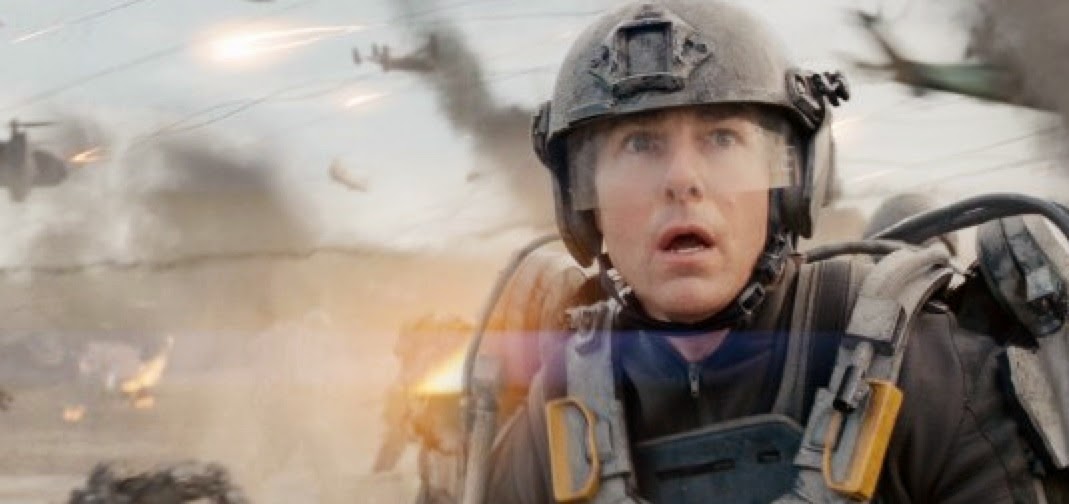
Following hot on the heels of Top Gun's 3D re-release, Edge Of Tomorrow gives audiences another change to see Tom Cruise's million-watt smile in 3D. The film is based on a Japanese novel called All You Need Is Kill, though it deviates somewhat from the story's plot. The tale itself is a hodgepodge between Groundhog Day, Looper and director Doug Liman's own The Bourne Identity, while also calling to mind the rewards-based repetition that modern video games offer their players. More importantly than all that though, how is the 3D in Edge Of Tomorrow? Read on in our 3D-focused review to find out all you need to know!

Post-Converted 3D:

Edge Of Tomorrow was post-converted from 2D to 3D by Prime Focus World. Their approach to this film seems to be unique in 2014's crowded slate of post-converted films. Rather than hide the technique with a 'native lite' approach, they appear to have been directed to dial up the stereo at pivotal moments and dial it down in others. The beginning sequence is seemingly intentionally dull, before the visuals are dramatically opened up in a chaotic battle scene. We've seen visual 'kicks' before (think of the difference in The Wizard Of Oz between Kansas' monochromatic colours and the Technicolor world of Oz) but this is the first time we can recall one being initiated by a post-conversion team so strikingly.

The beginning sequence of Edge Of Tomorrow has 'flat' feeling 3D

The key to their success appears to be, perversely, how much of the opening sequence is kept close to its native 2D source. This lulls the audience's eyes into a relaxed state, before the post-conversion team shockingly uses scaled negative parallax to literally yo-yo soldiers in and out of the frame. It's a refreshingly brazen technique, and serves the narrative well; our anti-hero is being thrown from a comfortable world into a stark and gruesome reality. The shock is appropriate, and not as gaudy as it could have been in other contexts. The post-conversion team served the narrative well here, and it's likely the shock they were able to convey could not have been achieved if the film were shot in native 3D.


How's the depth of the 3D?

The depth varies wildly throughout the film. The battle scenes opt for a 'deep focus' that allows you to see for miles into the distance. Or, at least, you could if the camera kept still for long enough. The battle scenes are the most interesting visually, in that they provide an arresting focal point for each of Tom Cruise's character's (Cage) loops. One character dies as an object drops from the sky on him, and then in Cage's next iteration through the loop Cage saves the man before the object drops, and then the next loop Cage doesn't bother. Knowing the exact geography of the scene is important for Cage, and it's incredibly important the audience knows the impact of a character standing even a metre from their 'usual' position.


The film-makers attempt to show Cage's growing confidence grow with each new iteration. The camerawork is shaky and chaotic in his first few attempts at battle, and then slowly grows more steady and assured as he begins to learn the ropes. Unfortunately, this also means that the audiences eyes are expected to context-shift with each new iteration of Cage's battle. Your perception shifts from loop to loop; progressing from only seeing a few feet of depth behind Cage in his first loop, through to being eventually able to see for miles behind him as his skills develop. After enough rapid-fire edits and changes to the way the action is filmed, your eyes might wary and tire from all this visual change.


Does the 3D 'pop'?

As mentioned earlier, the opening battle scene is the primary example of negative parallax being used. Soldiers are thrown from a moving plane into a battle field below them, and some are accidentally suspended to the plane by rope. As the plane descends, they're flung at the audience in a yo-yo like technique that we wished had been included in The Amazing Spider-Man 2. The remainder of the film uses this type of technique relatively rarely, with the only 'popping' elements usually being restricted to debris and out of focus guns aimed at the camera. Again, this kind of inconsistency can contribute to some amount of eye strain, as audiences eyes attempt to process the inconsistently applied visuals.

Dull night-time visuals, with a lack of background contrast

Did it make sense to add 3D to Edge Of Tomorrow?

The film-makers made a lot of good choices when considering the idea of Edge Of Tomorrow as a 3D film. The action is largely set in daylight, and the characters contrast well against their backgrounds. However, they made a few missteps once the second act is over. The climactic set piece is largely set in the evening, and it's very hard to differentiate the dark-suited soldiers from their background. Their enemy is cloaked in shadow and similarly hard to pick out visually. Without the kind of bright neon offered in films like Prometheus or Tron: Legacy, these night-time scenes suffer visually, particularly if your local multiplex hasn't adjusted the brightness of their projector to accommodate 3D projection's light loss. Just in case you hadn't noticed a recurring theme in our review; this narrative and visual choice can also lead to eye strain in audiences.


The film itself

Edge Of Tomorrow is one of the most arresting and relentlessly entertaining blockbusters to have been released in recent years. Simply put, it's a gem of a sci-fi/action film. If you're a fan of shoot 'em up video games, this is the film for you. If you're a fan of the enigmatic and interesting stars, then this is further proof that they're A-list talent. If you've ever bemoaned the influx of comic book movies and sequels in the American Summer movie-going season, then you'll find Edge Of Tomorrow's originality refreshing. If you ever watched an action film and wished the female lead were tougher and more heroic than the male, then Emily Blunt's steely performance is going to make you feel better about Hollywood. It's a joy of a movie, let down only by a somewhat anti-climactic final minute of footage. If there were Oscars for crowd-pleasing films, this would be nominated in several categories.

If we had to archive one version, should we save the 2D or the 3D?

If you have the choice, see Edge Of Tomorrow in 2D. Buy the 2D Blu-Ray. Avoid the 3D version unless you're really curious. It's disappointing for us to say, but the 3D version is a noble failure. There's a bunch of great examples of stereo on display, but the eyestrain we suffered while watching can be traced back to several poor visual choices that other film-makers would do well to learn from. Just because you can post-convert from 2D to 3D, doesn't mean you should.

Monday, October 14, 2013

How's The 3D In 'Gravity'?


Background:

The best 3D film of the year? Ordinarily conservative critics have fallen over themselves to proclaim Gravity a landmark cinematic event, ranking it amongst distinguished 3D peers like Avatar, Hugo and Life Of Pi. James Cameron, the king of commercially successful 3D films, told Variety "I think it's the best space photography ever done, I think it’s the best space film ever done, and it's the movie I've been hungry to see for an awful long time." Riding a wave of breathless hype, Gravity broke US October box-office records, and is fast becoming the 'word of mouth' hit of the year. So... does it live up to the praise? Is Gravity a ground-breaking achievement in 3D film-making?

Post-converted / Natively Rendered 3D:

Modern-day 3D films are produced through three broadly classifiable means; 'native 3D' (where the majority of the movie was shot with stereoscopically capable cameras that have two lenses to capture the information in 'true' 3D), 'post-converted 3D' (where the film was shot largely in 2D by a camera that had one lens, and then later converted into stereo by a company that separates out layers of the 2D footage digitally) or what we at 3Defence call 'rendered 3D'. Often the latter might be a film like Toy Story 3; a digital construction where animated characters exist inside a virtual environment that has mathematically accurate axes, horizons and depth. Wall-E or Up's 3D effects are not automated by any means, but their film-makers do have a geographical point of reference when applying stereo to their rendered footage. Pixar's reconstruction team re-made Finding Nemo 3D in this way, modifying source elements to render out to stereo footage in a way that made sense physically... but in actuality differed from its 2D predecessor. It's all a little bit confusing, and is not nearly as straight-forward as you'd think!


Anyway, that's a gigantic tangent, but we bring it up because Gravity defies classification. The very concept of "post" production is moot; nearly every shot is a 'special effect' stitched together by talented rotoscopers, artists and technicians. When you see a shot of George Clooney's face, it was shot in 'mono' using a 2D camera rig, then post-converted into 3D by Prime Focus World. Complicating definition though is that this face was then superimposed inside a digital spacesuit, which was then placed into a virtual environment, such as the Hubble telescope or the exterior of the ISS. The resulting face is thus just another layer of a natively rendered output. Closer to one of Pixar's rendered 3D films than the post-converted 3D of World War Z. As fiendishly complex as it is to explain this, it must have been doubly more so to actually film it! Gravity was originally due for a November 2012 release date, but the film was granted another half a year to get its effects 'just right', and we can safely say you won't believe your eyes.

The only comparison in modern cinema, as best as we know, is Avatar. While Avatar is famed for being a 'native 3D' film, and indeed much of it was filmed with real 3D cameras on real sound-stages with real humans, a large portion of that movie was rendered through Weta Digital's server farms, with animated characters interacting with filmed ones, creating an 'informed' 3D post-conversion. Gravity, it seems, was made with a similar approach. We can therefore label Gravity as something of a 3D anomaly; a post-converted / natively rendered 3D film.


Does the 3D 'pop'?

Despite the title, there sure are a lot of scenes set in a zero-gravity environment. The possibility of things floating out towards the audience is endless, and doubly so because Gravity is a largely digital creation. The only thing stopping this from happening ad nauseam is Oscar-nominated director Alfonso Cuarón's curative tastes. Negative parallax effects in Gravity are used sparingly, but when they are used they are at optimum points in the narrative, with a pre-determined purpose. Cuarón deploys such 'popping out at the audience' moments in the same way that a master roller-coaster designer might give their riders a brief moment of respite... before then flinging them into an unforeseen and terrifying corkscrew. In Gravity, these 3D effects are therefore used as some sort of appropriately inverse cliffhanger; a second or two of levity before a new and even more dire situation is revealed. The overt manipulation of the audience's emotions is stunning in its simplicity. Cuarón giveth and Cuarón taketh away our movie-going delight in a way that hasn't been seen since the heydays of Kubrick or Spielberg.


How's the depth of the 3D?

The great thing about space is that it's infinite. The terrifying thing about it is also... that it's infinite. From a cinematic perspective, we've never seen that scale conveyed before. We've all seen space-walks on-screen, but we've never felt like one wrong move by an astronaut might send our favourite character spinning into an endless purgatory of relentless high-speed rotation. Space has never been as dangerous as it is in Gravity. Very quickly, you learn to fear "the blind" that exists outside of Earth's orbit, where stars stretch out into a distant blanket of darkness. Of course, you'll also learn to fear what lurks within Earth's orbit, hurtling around the planet at many thousands of miles per hour, approaching far too rapidly from a distant horizon. And you'll appreciate too that a hasty descent to Earth could kill a rogue traveller in their spacesuit, as the continents of our world loom discomfortingly large. Ordinary "Sci-Fi" genre pictures usually rely on exposition to explain all this to their audience, but in Gravity these chilling facts are often conveyed visually; we innately understand the primal fear of our heroes plight, by layers of depth masterfully created by Cuarón and his cinematographer Emmanuel Lubezki.


Did it make sense to add 3D to Gravity?

In the '90s and early 2000s, directors were ramping up excitement levels by shaking the camera and rapidy cutting from one high octane shot to the next. Gravity proves that cinema is able to move beyond such gimmicks, with its long, steady, shots and fluid choreography. Perhaps it might not have seemed the 'perfect' candidate for 3D a few years ago, but coming at the end of a Hollywood blockbuster season stuffed to the gills of shaky-cam 3D epics, Gravity's deliberate pacing and meticulous camera-work seem positively inspired. 3Defence was reminded (as we learned from The Wizard Of Oz recently) that audience's eyes crave the ability to rove around a stereo frame. There is a noticeable feeling of "immersion" when we are allowed to choose what to focus on within a deep-focus shot. More than anything, Gravity showed us that a new language of film-making is possibly still to come for "the best" 3D experience. This is a modern medium that is still finding its feet, and Gravity can rightly be considered a new touchstone for future directors to build upon.

The film itself

Gravity, at the time of writing, has an average rating of 96% on Metacritic. That's not to say the film is "perfect", but it does mean that hardened reviewers are imploring their readers to see Gravity on the biggest screen possible, at their soonest convenience. If it's not clear already, we at 3Defence consider this more of a 'thrill ride' than a cerebral and thought-provoking epic. We don't mean to diminish Gravity's impact in saying that though. We just want to warn you that this has more in common with Sandra Bullock's Speed than it does with Cuarón's thinking-man's sci-fi epic Children Of Men. From our perspective, that's a good thing. Provided you go in with those expectations, you'll have a white-knuckle thrill-ride, the likes of which you can usually only find in a theme park.

If we had to archive one version, should we save the 2D or the 3D?

It's hard to know right now if the hype for this film will last into the next few decades or not. It's unlikely that people in 3013 will look back at Gravity in the same way as they do for 2001: A Space Odyssey or Voyage Dans La Lune. But as of this moment in time, Gravity is a monumental success as much because of its usage of 3D as its taught plot or excellent casting choices. The 3D version is the definitive version as best as we can see, and - if for no other reason than an eventual curio in the ongoing development of modern stereoscopic cinema - the 3D version of Gravity is the one we'd advocate be archived. It's hopefully going to show the way forward for other directors who will build on the lessons taught to them by Cuarón and his team. It certainly looks like another 3D film that will reap Oscars and Golden Globes come early 2014!

Sunday, September 29, 2013

How's The 3D In 'The Wizard Of Oz 3D'?

Background:

Ask anyone of Generation Y "what's the oldest film you've ever seen?" and there's a very good chance that (after some prodding) the answer is The Wizard Of Oz. The Victor Fleming film was released in 1939, with World War II a month away from breaking out in Europe. Bizarrely - considering its legacy nowadays - Oz was something of a commercial misfire for MGM at the time. One of the studio's most lavish and expensive productions, it took a few re-releases for The Wizard Of Oz to fully recoup its costs and, more importantly, to be seen by subsequent generations as a landmark event in cinema. The better part of a century later, Warner Brothers now owns the film's rights, and Dorothy's had more "special anniversary box-sets" released than 3Defence cares to count. Warners probably figured out that, after fans have already bought the film on VHS, DVD and Blu-Ray in 2009, they needed to do something particularly special this time around. So, for a limited time only, viewers get to see the film on IMAX screens around the world, in post-converted 3D. How'd they do with the stereo? Is this re-release worth the trip to the big screen?

Post-Converted 3D:

This is actually the second 3D trip to Oz viewers get this year; Sam Raimi's native-3D Oz The Great And Powerful underwhelmed us in April. The Wizard Of Oz is a different beast entirely, because it's the oldest live-action feature film to be converted into 3D. It's much older than the likes of Titanic 3D or Jurassic Park, which both benefited from being originally filmed with cutting-edge 1990s technology. Put simply, getting any version of Oz onto the big-screen in a format that discerning audiences would find tolerable is hard enough; and getting a 3D version looking good seems nigh-on impossible. So, let's take a moment to discuss the restoration of the film, and then we can take a closer look at the technical feat of the stereo-conversion.


Filmed with a mixture of three-strip Technicolor and sepia-toned black & white footage, The Wizard Of Oz conformed to the original Academy aspect ratio of 1.33:1 (aka "4:3"). This means it fits better on the screen of your square-looking 1990s CRT TV than it does to your rectangular 16:9 LED TV from the mid-2000s. Likewise, if you project it correctly on a modern-day big-screen, the film will leave vertical 'letter-boxing' lines to the left and right of the image. It's unusual for 3D films to deal with this framing, though we've seen varieties of the square look in Katy Perry's 3D backstage footage and the Raimi Oz film's opening sequence.


The aspect ratio's reasonably easy to accommodate though. The real challenge for any team restoring Wizard Of Oz is the Technicolor negatives. The version you're familiar with of the film is actually an amazing combination of three strips of differently coloured images, layered on top of one another to form an image that makes sense visually as 'realistic colour'. Most Wizard Of Oz re-releases to date have been restorations of that 'end product': the original combination print. What makes the 2013 restoration different though, is that the studio restored and scanned each of the original three colourized layers again (cyan, magenta and yellow) then combined them again into a fresh combination print. The restoration team had a further challenge too - some of these negatives had shrunk to different sizes from one another! What was once "35mm" film was now 34mm in some cases! The team had their work cut out for them. Because of such quirks in this process, you're effectively watching a different film than audiences did in 1939. You're watching a sharper image than the original audiences ever had the chance to; processing these images digitally allowed the restoration team to precisely align each layer on top of one another, and removed the chance of accidental blurring occurring if a strip of film was misaligned.


After months of work, Warner Brothers were able to give Prime Focus World a 4K print that looked more crisp and detailed than any print of the film to date. As the firm's CEO put it, "to be trusted with one of the best known films of all time – an important part of American popular culture – is truly humbling." One challenge unique to this conversion is the average length of each shot in the film; being a 1930s MGM musical, the cuts from one shot to another are purposeful and at a much slower pace than the rapid-fire edits of a modern-day musical like Les Misérables or Chicago. As a consequence, Prime Focus World had to be just as purposeful with how they chose to use 3D in a shot that might run upwards of 30 seconds, lest audience's eyes wander about the frame and find gaps or errors in the chosen stereo effects. All up, the conversion took around 16 months to complete, which possibly makes it the longest conversion in film history.


Does The Wizard Of Oz's 3D 'pop'?

Warner Brothers' Chief Preservation Officer, Ned Price said to Variety “I don’t like 3D unless it’s really good 3D ... so I was probably a good pick to rein in the people we worked with. They’re very good people over at Prime Focus but I think I kept them honest.” Needless to say, Price largely avoided having flying monkeys pop out of the screen, or fireballs thrown at the audience. The few elements of the film that extend towards the screen are usually associated with the Wicked Witch, whose angular nose, fingers and hat occasionally venture outwards. However, the film is largely free of any "gimmicky" popping effects, and the 3D effects used are as conservative as Price's tastes allowed.


How's the depth of the 3D?

Until now, the backgrounds of The Wizard Of Oz looked either like very obvious matte paintings, or they looked like giant hand-painted backdrops that had reasonably obvious lines to the floor. Children might not notice, but adults surely did. In the 3D conversion process, Prime Focus World had to choose whether they made the backdrop look more 'flat' or if they enhance the suggested depth within it. They chose the latter, so the rolling green hills of Oz now look like they exist in three-dimensional space, albeit that they don't look like the pastures back home in Kansas. The effect of this is that the world of Oz feels more stylized than it did in previous versions, and now looks like a particularly fantastical land that feels effortlessly part-animated and part-photo-real. The effect is startling and breathes new life into each image. The haunted forests now stretch out for miles and you feel like lions-and-tigers-and-bears might actually lurk there. The witch's castle looms large over the landscape, as foreboding and terrifying as anything from The Two Towers. Munchkinland now seems brimming with more munchkins than ever before, because you can see how many dozens of characters are moving in the deep background of the wonderful sets there. The tornadoes in Kansas will seem more threatening than you remembered them, and more perilously close to the house Dorothy escapes to. Oz, for the first time in years, feels alive.


Did it make sense to add 3D to The Wizard Of Oz?

With its bright lights, vivid colours, inventive choreography, fantastical settings and varying planes of action (the Munchkins hiding in bushes when Dorothy first arrived were a real treat), The Wizard Of Oz is a natural fit with 3D. Many of the medium's current limitations are avoided thanks to the slow paced editing, locked-down camera work and artificially-lit studio sets. The only reason we can think of avoiding the conversion is that it would be very hard to pull off, and could seriously risk ruining the reputation of a beloved classic if done badly.

The film itself

3Defence has seen The Wizard Of Oz on the big-screen several times over the years, projected in 2D using 35mm. We've obviously all seen the film on TV sets throughout the past few decades, in varying quality of restoration or bastardization of the film's ratios or technical set-up. Throughout every permutation though, the unmistakable genius of the music, acting, set design, costumes, make-up and directing shine through. It doesn't matter what mood you're in, you'll be hooked by the episodic nature of the film's plot, and constantly be surprised at how breezy the narrative is. It's hard to define, but The Wizard Of Oz is one of those films that can hook in viewers of all ages, at any time of day, at any time in film history since its release. It truly is a magical piece of cinema.

If we had to archive one version, should we save the 2D or the 3D?

This question is one we ask for each 3Defence film review. Normally it's an easy enough one to answer, and we tend to side with the 2D version as often as we side with its 3D counterpart. Today though, we are asked to judge the nostalgic memory of a 2D cinematic classic, against the cold hard reality that no version of it exists that looks as detailed or as 'clear' as the 2013's version's remaster. This particular 3Defence reviewer has seen the film dozens of times, but has never seen it in such startling clarity as he did yesterday in IMAX 3D. The film's soundtrack and visuals have never been so lively, and you'll see details that enhance (rather than detract, like say the Star Wars Special Editions) a film that is already a masterpiece. The Scarecrow's makeup alone is worth the price of admission. In 3D, you'll pick up every texture available to be seen, and each detail adds to a more positive impression of the whole film. We're going to say "archive the 3D!" in this case, and we reserve the right to this opinion until an 8K (or suitably ludicrous) 2D remaster release is unveiled for the film's 80th Anniversary!

Tuesday, June 25, 2013

How's the 3D in World War Z?

Background:

World War Z is (loosely) based on a 2006 novel by Max Brooks. The book is a cracking read, and we were hoping the film would be just as outstanding as its source-material. The production of the film encountered multiple woes, all of which are well documented, but the first few trailers successfully dispelled most audience's doubts about the film. Indeed, in its first weekend, World War Z mightily exceeded all box-office expectations. Critics are divided on the film, while audiences are more generally positive towards horror and action pictures, so have dished out a healthy B+ CinemaScore.


Post-Converted 3D:

World War Z was shot in 2D, using Alexa cameras, and later post-converted into 3D by Prime Focus World. The firm delivered 2076 converted shots, assisted by 400 artists. The firm's website goes into great detail about the conversion, and when stereo firms rave about their own work we tend to listen. We've seen several projects recently where there has been next-to-nothing released officially about the post-conversion process. In contrast, the team involved with World War Z are proud to show off the collaboration they had with the film's creators, and they're glad to talk about their unique approach to 3D film-making. They need not talk too much about their work though, because the proof of it is in the theatre, where their work looked absolutely stunning.


Does the 3D 'pop'?

Like 28 Days Later and the Dawn Of The Dead remake before it, World War Z features fast-moving zombies. They're relentless in their pursuit of human flesh, and the undead have a nasty habit of popping at the living. The film-makers make full use of these jump scares, with teeth and clawed hands leaping out at their audience. The 3D effects used don't linger long enough to be hokey; instead they're employed to give you a good fright before the effects are dialled back down to 'classy' again. Between zombie attacks, 'noise elements' like lens flares or ash particles are layered enough to give the audience the perception they're really in the room with Brad Pitt.

How's the depth of the 3D?

Fantastic! The film is deceptively small-scale, and is focused (literally) on Brad Pitt's character throughout. Prime Focus World went above and beyond to map out Pitt's face in elaborate detail, so his character feels absolutely 'real' in terms of depth, even in close-ups. Their efforts pay off the most in dialogue scenes, where spatial integrity is maintained perfectly, to the point we'd swear some scenes were filmed in Native 3D. Often an 'over-the-shoulder' shot - where there are three planes of depth caused by an out of focus shoulder at the front of the shot - causes issues for post-conversion teams, sometimes resulting in obviously 'layered' visuals that feel artificial. In World War Z, this pitfall is avoided masterfully.


But you don't care about dialogue when it comes to a zombie film, do you? No. You care about the apocalypse! The damage wrought upon Israel, Korea and Philadelphia in World War Z is expertly staged by the film-makers, and their set-pieces are well designed to emphasise the magnitude of the unfolding disasters.  In 3D, the cataclysmic events seem that much more devastating, thanks to a large number of helicopter-based shots that help the audience contextualise and comprehend the undead chaos.


Did it make sense to add 3D to World War Z?

Not in the slightest. The major set-pieces are set in either cramped and dark areas, or dusty and monochromatic landscapes. The characters mostly wear plain looking clothes (which helps sell the realism of the situation) and the undead wear the same clothes too. Even the blood is neutered to be a digitally-altered black colour; presumably to reduce the rating to a PG-13 one that could help boost ticket sales. So, at face-value, this wouldn't be an obvious choice for a 3D film for us. We're happy the team at Prime Focus World proved us wrong though. Perhaps we'll have to revise what our criteria for a '3D-appropriate' film is. There are scenes set in pitch-black rain that work great here, with zero eye strain, and perfect visual clarity achieved. There are others that allow us to focus on one tiny detail amongst a sprawling mass of creatures. It's a great example of what 2013's 3D technology is capable of, and it's another film that proves that post-conversions are capable of standing toe-to-toe with Native 3D works now.

The film itself

Fans of the book's non-linear timeline and documentary style will probably hate World War Z. Likewise, true zombie genre fans. And it's possible those who wanted to see a 'world war' will be disappointed they're instead given a film about a UN health inspector... ha. For one final caveat, it's possible that Palestinian sympathisers will find images in the film unsettling, but then again the film deals with that issue directly and it's therefore hard to argue a sub-textual agenda. With all these caveats out of the way, we found World War Z a perfectly executed Hollywood disaster picture. This isn't a zombie film. Instead, it deserves to be compared to the likes of 2012, The Day After Tomorrow, Armageddon and Deep Impact. In company like that, Z shines. It's far smarter than it deserves to be.

If we had to archive one version, should we save the 2D or the 3D?

In case it's not been obvious enough yet, we'd recommend archiving the 3D version of World War Z. It's a great post-conversion, and you only gain appreciation for the film by seeing it in 3D.

Tuesday, October 23, 2012

How Good Is The 3D in 'Frankenweenie'?

Background:

Frankenweenie is one of the more unlikely films to be released this year. Black and white, 3D, stop-motion animated, released by Disney, and an homage to 1930s horror films from Universal... you know, for kids! Bizarrely, this is the second time its director, Tim Burton, has tried to get the film made. Many years ago, the project was canned, after an exec realised that its subject matter might be a little, erm, off-putting. So, why has Frankenweenie been made now? We're inclined to blame Alice In Wonderland; after earning a billion dollars at the global box-office (despite its atrocious 3D effects) Tim Burton was probably in a solid bargaining position to get a few 'personal projects' made. But who cares about all that background info, you're here because you want to know... how good is the 3D in Frankenweenie? Should you see it with, or without, glasses on?

Post-Converted 3D:

Given Burton's history with post-converted 3D, we were worried how Frankenweenie would fare through the process. Luckily, the technology has come a long way since the release of Alice In Wonderland. The conversion was handled by Prime Focus World. Remember our glowing review of Men In Black 3's converted 3D? Prime Focus World were behind most of that gig too; they're fast becoming 3Defence's favourite post-conversion team. For Frankenweenie, they worked on 1500+ shots, and based themselves nearby the shooting locations, so they could confer with Burton and his animation team whenever they needed reference points for their work.

Does the 3D 'pop'?

Yes. Though there's not a lot of shots that use the 'pop out of the screen' effect, the few gags that do are well-timed and designed to capture the audience's attention. Frankenweenie adheres to a common trend in 3D films from 2012: elements like rain and lightning are being brought forward in the 'mix' to seemingly occur in the movie theatre itself, as well as in multiple panes of depth around the film's characters. We're wary the effect could get over-used, but for now we think it works ok, if only because it feels like the real world: rain falls in unpredictable places, so it makes sense that it's allowed to transcend the boundary of 'screen' and 'theatre'.


How's the depth of the 3D?

Frankenweenie's stereographer, Richard Baker, summarises his approach to depth well, so we'll let him speak for himself: "3D for me shouldn’t be a window into the screen. You need to feel surrounded by the movie to become truly immersed in the story. This was central to our planning when designing the 3D and creating the depth script. We had the opportunity to exaggerate the scale and depth much more than we would on a live-action show to really heighten dramatic moments, and we were also able to combat the miniaturisation of the puppets by using depth as a creative tool." We're glad to report that he succeeded in his goals: despite being filmed on small sets, with tiny figurines as actors, Frankenweenie's locations feel cavernous, lived-in, and they reach into the distance in a way that the 1930s films it's riffing on could never have dreamed of doing.

Did it make sense to add 3D to Frankenweenie?

No! Not by any stretch of the imagination did it sound like a good idea to post-convert a Black And White, stop-motion animated, film referencing incredibly flat (the sets were often cardboard, with smoke effects to disguise the lack of a real background) 1930s horror films. Are we glad they did it anyway? Hell yes. This is the first time we've seen a Black And White 3D film in the modern day, and it looks glorious. If you take your glasses off during the film, you'll notice the screen looks fairly harsh, with big contrast ratios between the deep blacks and the bright whites. Put your glasses on again though, and then a world of deep grey is revealed; probably the best greys we've seen in a monochromatic film since the wonderfully shot Schindler's List. Normally 3Defence insists that 3D films need to be brightly lit, and vibrantly colourful... but Tim Burton and his post-conversion team have proven us wrong with Frankenweenie.


If we had to archive one version, should we save the 3D or the 2D?

The 3D version must be considered the 'definitive' version of Frankenweenie. If you're wondering "should I see Frankenweenie in 3D or in 2D" and you can afford the extra dollar or so, you ought to view this film with glasses on. The 3D brings depth that doesn't exist to the shots, and makes the world of our titular re-animated dog come alive (pun intended). The editing deserves mention too: it's cut at a leisurely pace, which is appropriate for the 1930s-style genre, but this has the added benefit of making the 3D experience easier on your eyes than modern-day films that are designed for a 2D screen. We at 3Defence watch a lot of 3D films, and we're quietly confident that Frankenweenie will be considered the gold-standard in post-converted 3D films for a long time. 

The film itself

Make no mistake about it, Frankenweenie is a modern-day Tim Burton film. You can interpret that whichever way you please, but for us here at 3Defence that means; predictable character 'arcs', unusual preoccupation with genre conventions, amazing set design and stylistic flare, fantastically over-orchestrated music, and a rushed / borderline incomprehensible third act. Burton is in the business of world-building, and we'd love to see him work with someone other than screenwriter John August soon. Frankenweenie wreaks of 'pet project' (yes, pun intended) and that usually means "no-one said 'no' to the director at any stage along the way." Frankenweenie is a lesser film in Burton's filmography, but it's a long way from his worst. File this nearer to Mars Attacks than something like Planet of the Apes