Showing posts with label Emmanuel Lubezki. Show all posts

Sunday, March 30, 2014

46% of 2014's Oscar Winners Were 3D Films


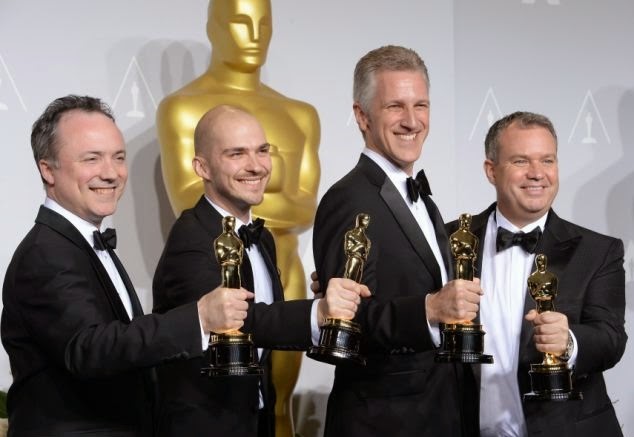
The 86th Academy Awards were held in March, hosted by Ellen DeGeneres. When the gathered stars and glitterati weren't taking selfies, the famous gold statues were being handed out to a host of worthy winners. Amongst them, 3Defence counted 11 wins for 3D films, helped mostly by Gravity, but ably assisted by Frozen and The Great Gatsby. This means that 46% of 2014's Oscar winners were 3D films. By comparison, 21% of 2013's winners were stereo movies, and 23% of 2012's were too. So, why the meteoric rise this year?


Gravity - as many predicted - swept the majority of the 'technical' categories. It took out the Visual Effects, Sound Editing, and Sound Mixing awards early on in the evening. These particular awards have been given to 3D films in the past. Cinematography and Film Editing came next though, and winning both of these awards is a significant breakthrough in terms of the industry's recognition of stereo film-making. For one thing, the teams working on both fields for Gravity were utterly dependent on each other to succeed. Emmanuel Lubezki's cinematography filmed the unfilmable, and had to predict where effects and edits would be made many years before they could be finished. Alfonso Cuarón and Mark Sanger's editing stitched together hundreds of shots and effects into a seamless whole, to the point where their edits were nearly invisible to the audience. Their combined achievements meant that 3D cinema was awarded its first Best Film Editing Academy Award.


Steven Price took out the Best Original Score Oscar for Gravity too, joining Life Of Pi and Up's composers as the third 3D film to win that particular award. Finally, Alfonso Cuarón won the Best Director award for the film. After Ang Lee's win last year, this makes it the second year in a row that the Academy has awarded a director of a 3D film... and then not awarded them a Best Picture Oscar to boot. 12 Years A Slave pipped Gravity to that eventual win, and by all accounts the race was very tight.


As mentioned earlier, it wasn't just Gravity cleaning up at the Oscars; smash hit Frozen picked up 2 golden statues. Frozen has widely been regarded as a 'return to form' for Disney's animation division, and is the first time the animation studio has won an Academy Award in 14 years. The film has now earned over $1 billion at the global box office (ably helped by 3D ticket surcharges) and one of its songs Let It Go reached the Billboard Top 10. That particular achievement may have helped the studio win Best Original Song, and it also picked up an award for Best Animated Feature.


Finally, the immaculately designed and photographed The Great Gatsby picked up 2 Academy Awards also. Catherine Martin & Beverley Dunn were rewarded for their efforts in Production Design. Following wins from Avatar, Hugo, and Alice In Wonderland, this category is beginning to look like a 3D-dominated one. Catherine Martin picked up another gong for Best Costume Design (another category that Alice In Wonderland took out a few years ago). Gatsby's opulent aesthetic has had a major cultural influence in music videos and dress-up parties this year, and the decadence came alive wonderfully in stereo.

In a few years' time, a 3D film may eventually take home the Best Picture Oscar. While it hasn't happened this year, it's still great to see the film industry recognising the craftsmanship of stereo film-making. We at 3Defence heartily congratulate the likes of Catherine Martin, Mark Sanger and their esteemed peers for their efforts in making 2013 a banner year for 3D cinema.

Friday, January 31, 2014

And the Oscar goes to... a 3D film?


This year's Awards Season is gearing up for its main event: the 86th Academy Awards. Many cinephiles justifiably find the concept of 'Awards Season' horrifying. They can validly cite examples through the years where Oscar was wrong  (My Fair Lady over Strangelove? Crash over Good Night and Good Luck? Shakespeare In Love being allowed in the same room as the first 20 minutes of Saving Private Ryan?) and they can cite many more examples where films "should at least have been nominated!" Thankfully, the Academy broadened the nomination pool after universal outcry at The Dark Knight's nomination snub in 2008, and that's alleviated those tensions a little. It means we get a more balanced summary of the year in cinema: edgier films get nominated (District 9, Amour), and broader-playing fare (Up, The Help) makes the cut as a nearer summary of what movie-goers... go to the movies for in the first place.

The Nominees

2013's nominees are typical of the post-Dark Knight era: a David O. Russell "actor's movie"; a film about American racial discrimination; a couple of films about elderly people; a movie about finding love in an unlikely place; a smattering of biopics and... a 3D film. Wait, what was that? A 3D film, nominated for Best Picture? You got it. Every year since 2008 there has been at least one 3D film nominated for Hollywood's biggest accolade. In 2009, there was Avatar and Up. In 2010, Pixar stayed the course with Toy Story 3. Scorsese's Hugo literally popped out of the screen in 2011. Life Of Pi followed in 2012, and now we have the big kahuna: Gravity. We'll get to Gravity's chances later though.


For now, let's discuss what this means for the acceptance of 3D in Hollywood and the 'mainstream'. Does it mean anything at all? Given the post-Dark Knight boom in Oscar nominations, it seems easy to discredit any significance a 3D-focused site like ours might impose. So, we've decided to go one further. Today we're going to look at broader trends within The Academy Awards for the nomination of 3D films in the modern age, to see if we can read the tea-leaves for Hollywood's true view on 3D movie-making.


Cinematography

From 1928 onwards, every Academy Award for Best Cinematography was given to a 2D movie. Depth was communicated with focus pulling, the mono illusion of parralax, or a savvy combination of both. Those two concepts were fundamental to how cinematography "worked". At least, that was how it "worked" until 2009. That year, Mauro Fiore took home an Oscar for his revolutionary work on the 3D film Avatar. Two years later (enough time for Hollywood to hastily revisit this whole 3D business) Robert Richardson deservedly earned his third Oscar for his stereo work on Hugo. The 85th Academy Awards officially made it a trend: Claudio Miranda and his team were rewarded for working with the ocean & kids & animals & 3D on Life Of Pi. And guess what? 2013's Best Cinematography Oscar has another 3D film nominated: Gravity. We'll find out how realistic Emmanuel Lubezki's chances are after the American Society of Cinematographers announce their Award for Outstanding Achievement later tonight.


Visual Effects

So, we've established there's a trend underway for 3D Best Picture nominees, and 3D Best Cinematography winners. What about any other categories? As it happens, 3Defence has done deeper digging to reveal other surprises. The Academy Award for Best Visual Effects has been inundated with 3D films. This isn't that surprising: visual effects are expensive, and 3D is where the money is these days. The exponential growth in this field is surprising though. In 2006, Superman Returns was the first (partial) 3D film to be nominated in the category, Avatar was the first to win, and then - like the cinematography field - two years later a veritable deluge arrived. 2010 had one 3D nominee (Alice In Wonderland), while 2011 saw a 3D winner (Hugo) and 2 nominees (Transformers 3, and Harry Potter 7.5). 2012 saw another 3D winner (Life Of Pi) and 3 nominees (The Hobbit 1/3, The Avengers 1, and Alien 0.5 Prometheus). 2013... 4 of the 5 nominees are 3D movies (The Hobbit 2/3, Iron Man 3, Star Trek 12 2, and of course, Gravity). While we're a wee way off from 2014's nominees, it's fair to assume that we'll see a similar ratio of nominees this year (likely contenders are The Planet of The Apes 8 2, The Hobbit 3/3, Maleficent and Transformers 4), and probably the following year too. 3D is here to stay in the visual effects category.

Animation

You'd imagine that, having exhausted the two most obviously 'visual' categories, we'd be done with the 3D-focused trend at the Oscars... but then you'd be forgetting Best Animated Feature. Guess what? Since 2008, 4 out of 5 Animated Feature winners were 3D films (WALL-E, Up, Toy Story 3 and Brave), and in addition to that, 10 of the nominees were 3D films too. It's a hard call who will win this year; will the 2D Miyazaki effort The Wind Rises reward the animation legend for his years of long-service, or will the Academy bow to the populist choice and reward the 3D hit musical Frozen? At this point we'd peg the chances for both at 50:50.


Other Technical Categories

Following on from these trends, 9 Oscars for 3D films have also been dealt out amongst the Production Design, Sound Editing, Sound Mixing, Original Score,  Costume Design, and Best Original Song categories. Notable absences can be found in the editing, hair & makeup, costume and two screenplay categories. It's possible Gravity will buck the trend for editing, and The Great Gatsby does the same for Costume Design, but we wouldn't recommend betting the house on either!


A 3D Film For Best Picture?

Which leads us back to Gravity's Best Picture nomination. Will it be the first 3D film to win the industry's most coveted of awards? It's got good chances. In its director, Alfonso Cuarón, the film has a 'career come-back' narrative that Academy voters love (his last film, Children Of Men, was well regarded critically, but poorly attended at the box-office). The film has the 'popular vote' sewn up, with wider audiences still paying millions to see it on the big-screen, despite it being 3+ months into its cinematic release. The Director's Guild of America gave its top honour to Cuarón, and the Producer's Guild gave a rare tie to Gravity and 12 Years A Slave. The scales are weighed in Gravity's favour, save for one thing: it's not got many actors in it. 22% of Academy voters are actors, and they have historically bestowed Best Picture awards out to, well, 'showy' films with large casts (see Crash, for example). It's certainly possible their enduring love for Sandra Bullock will help out Gravity's chances, but we at 3Defence would be weary of giving the film more than 60:40 odds to take out the Best Picture Oscar.


Still, the very fact this conversation is possible is amazing. Within a month's time, either 3D movie-making will either finally be legitimized, or we will have to wait for another year to have this debate all over again. No matter what happens, it's clear that - from Hollywood's perspective at least - 3D is here to stay. The movie industry's own voters are recognising the technical excellence being used to pull off stereo movies convincingly, and are rewarding their talented crew and studios accordingly. Fingers crossed Gravity helps break some more records on March 2nd!

Monday, October 14, 2013

How's The 3D In 'Gravity'?


Background:

The best 3D film of the year? Ordinarily conservative critics have fallen over themselves to proclaim Gravity a landmark cinematic event, ranking it amongst distinguished 3D peers like Avatar, Hugo and Life Of Pi. James Cameron, the king of commercially successful 3D films, told Variety "I think it's the best space photography ever done, I think it’s the best space film ever done, and it's the movie I've been hungry to see for an awful long time." Riding a wave of breathless hype, Gravity broke US October box-office records, and is fast becoming the 'word of mouth' hit of the year. So... does it live up to the praise? Is Gravity a ground-breaking achievement in 3D film-making?

Post-converted / Natively Rendered 3D:

Modern-day 3D films are produced through three broadly classifiable means; 'native 3D' (where the majority of the movie was shot with stereoscopically capable cameras that have two lenses to capture the information in 'true' 3D), 'post-converted 3D' (where the film was shot largely in 2D by a camera that had one lens, and then later converted into stereo by a company that separates out layers of the 2D footage digitally) or what we at 3Defence call 'rendered 3D'. Often the latter might be a film like Toy Story 3; a digital construction where animated characters exist inside a virtual environment that has mathematically accurate axes, horizons and depth. Wall-E or Up's 3D effects are not automated by any means, but their film-makers do have a geographical point of reference when applying stereo to their rendered footage. Pixar's reconstruction team re-made Finding Nemo 3D in this way, modifying source elements to render out to stereo footage in a way that made sense physically... but in actuality differed from its 2D predecessor. It's all a little bit confusing, and is not nearly as straight-forward as you'd think!


Anyway, that's a gigantic tangent, but we bring it up because Gravity defies classification. The very concept of "post" production is moot; nearly every shot is a 'special effect' stitched together by talented rotoscopers, artists and technicians. When you see a shot of George Clooney's face, it was shot in 'mono' using a 2D camera rig, then post-converted into 3D by Prime Focus World. Complicating definition though is that this face was then superimposed inside a digital spacesuit, which was then placed into a virtual environment, such as the Hubble telescope or the exterior of the ISS. The resulting face is thus just another layer of a natively rendered output. Closer to one of Pixar's rendered 3D films than the post-converted 3D of World War Z. As fiendishly complex as it is to explain this, it must have been doubly more so to actually film it! Gravity was originally due for a November 2012 release date, but the film was granted another half a year to get its effects 'just right', and we can safely say you won't believe your eyes.

The only comparison in modern cinema, as best as we know, is Avatar. While Avatar is famed for being a 'native 3D' film, and indeed much of it was filmed with real 3D cameras on real sound-stages with real humans, a large portion of that movie was rendered through Weta Digital's server farms, with animated characters interacting with filmed ones, creating an 'informed' 3D post-conversion. Gravity, it seems, was made with a similar approach. We can therefore label Gravity as something of a 3D anomaly; a post-converted / natively rendered 3D film.


Does the 3D 'pop'?

Despite the title, there sure are a lot of scenes set in a zero-gravity environment. The possibility of things floating out towards the audience is endless, and doubly so because Gravity is a largely digital creation. The only thing stopping this from happening ad nauseam is Oscar-nominated director Alfonso Cuarón's curative tastes. Negative parallax effects in Gravity are used sparingly, but when they are used they are at optimum points in the narrative, with a pre-determined purpose. Cuarón deploys such 'popping out at the audience' moments in the same way that a master roller-coaster designer might give their riders a brief moment of respite... before then flinging them into an unforeseen and terrifying corkscrew. In Gravity, these 3D effects are therefore used as some sort of appropriately inverse cliffhanger; a second or two of levity before a new and even more dire situation is revealed. The overt manipulation of the audience's emotions is stunning in its simplicity. Cuarón giveth and Cuarón taketh away our movie-going delight in a way that hasn't been seen since the heydays of Kubrick or Spielberg.


How's the depth of the 3D?

The great thing about space is that it's infinite. The terrifying thing about it is also... that it's infinite. From a cinematic perspective, we've never seen that scale conveyed before. We've all seen space-walks on-screen, but we've never felt like one wrong move by an astronaut might send our favourite character spinning into an endless purgatory of relentless high-speed rotation. Space has never been as dangerous as it is in Gravity. Very quickly, you learn to fear "the blind" that exists outside of Earth's orbit, where stars stretch out into a distant blanket of darkness. Of course, you'll also learn to fear what lurks within Earth's orbit, hurtling around the planet at many thousands of miles per hour, approaching far too rapidly from a distant horizon. And you'll appreciate too that a hasty descent to Earth could kill a rogue traveller in their spacesuit, as the continents of our world loom discomfortingly large. Ordinary "Sci-Fi" genre pictures usually rely on exposition to explain all this to their audience, but in Gravity these chilling facts are often conveyed visually; we innately understand the primal fear of our heroes plight, by layers of depth masterfully created by Cuarón and his cinematographer Emmanuel Lubezki.


Did it make sense to add 3D to Gravity?

In the '90s and early 2000s, directors were ramping up excitement levels by shaking the camera and rapidy cutting from one high octane shot to the next. Gravity proves that cinema is able to move beyond such gimmicks, with its long, steady, shots and fluid choreography. Perhaps it might not have seemed the 'perfect' candidate for 3D a few years ago, but coming at the end of a Hollywood blockbuster season stuffed to the gills of shaky-cam 3D epics, Gravity's deliberate pacing and meticulous camera-work seem positively inspired. 3Defence was reminded (as we learned from The Wizard Of Oz recently) that audience's eyes crave the ability to rove around a stereo frame. There is a noticeable feeling of "immersion" when we are allowed to choose what to focus on within a deep-focus shot. More than anything, Gravity showed us that a new language of film-making is possibly still to come for "the best" 3D experience. This is a modern medium that is still finding its feet, and Gravity can rightly be considered a new touchstone for future directors to build upon.

The film itself

Gravity, at the time of writing, has an average rating of 96% on Metacritic. That's not to say the film is "perfect", but it does mean that hardened reviewers are imploring their readers to see Gravity on the biggest screen possible, at their soonest convenience. If it's not clear already, we at 3Defence consider this more of a 'thrill ride' than a cerebral and thought-provoking epic. We don't mean to diminish Gravity's impact in saying that though. We just want to warn you that this has more in common with Sandra Bullock's Speed than it does with Cuarón's thinking-man's sci-fi epic Children Of Men. From our perspective, that's a good thing. Provided you go in with those expectations, you'll have a white-knuckle thrill-ride, the likes of which you can usually only find in a theme park.

If we had to archive one version, should we save the 2D or the 3D?

It's hard to know right now if the hype for this film will last into the next few decades or not. It's unlikely that people in 3013 will look back at Gravity in the same way as they do for 2001: A Space Odyssey or Voyage Dans La Lune. But as of this moment in time, Gravity is a monumental success as much because of its usage of 3D as its taught plot or excellent casting choices. The 3D version is the definitive version as best as we can see, and - if for no other reason than an eventual curio in the ongoing development of modern stereoscopic cinema - the 3D version of Gravity is the one we'd advocate be archived. It's hopefully going to show the way forward for other directors who will build on the lessons taught to them by Cuarón and his team. It certainly looks like another 3D film that will reap Oscars and Golden Globes come early 2014!

Thursday, September 19, 2013

Gravity - the best 3D film of 2013?

Alfonso Cuarón's upcoming 3D film Gravity has critics spellbound, and looks to be this year's "Must-See 3D Film". Set miles above Earth, the film stars George Clooney and Sandra Bullock as a pair of astronauts who... have to deal with gravity after a high-speed encounter with space debris. Gravity premiered at the Toronto International Film Festival earlier this month, and immediately started generating Oscar-buzz from the dumbstruck audience.


It sounds like cinematographer Emmanuel Lubezki's first 3D outing is a doozy, technically-speaking. Breathless reviewers have described long, unbroken, takes that last in the range of 10 - 15 minutes. HitFix's Drew McWeeny appropriately summed up most people's reactions: "It is increasingly rare that I look at an effects-heavy film and don't know immediately how they did it. With Gravity, I'm not even sure what was real and what wasn't." Indeed, if you watch any of the film's trailers or TV Spots, there's a good chance you'll have the same reaction:


So, what of the 3D? 3Defence hasn't had a chance to catch a sneak-peek yet, but we can report the media has spoken very favourably of the 3D effects used. Cuarón designed the film with an IMAX 3D release in mind, and has apparently made dizzying use of the medium, with epic shots of Earth set beyond the stratosphere. In these pictures released this week, you get a chance to see for yourself what the fuss is about. What do you think? Will this be another over-hyped release, or one that will help strengthen 3D's reputation in 2013?